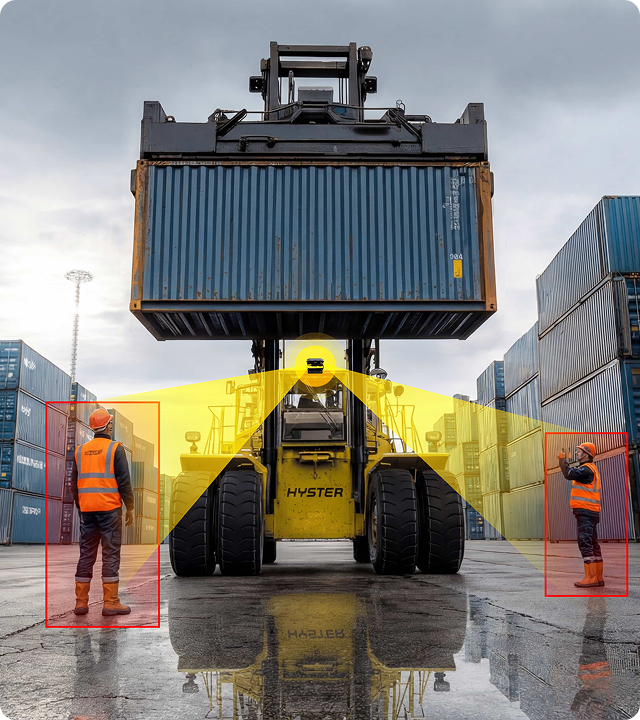
In high-risk industrial environments, safety technologies are often deployed with the best of intentions. They are designed to protect pedestrians near heavy equipment, reduce collisions, and support workplace EHS protocols. But a system that triggers alerts too frequently or inaccurately can steadily become its own kind of hazard. False positives, where an alarm is activated by inanimate objects, erratic sensor behaviour, or misunderstood movements, not only disrupt workflow – they erode trust between humans and the machines they interact with every single day. And when trust in a safety system begins to break down, workers may begin to tune it out entirely. The result is a subtle but serious risk: over time, critical warnings lose their urgency, and near-misses become inevitabilities.
A 2024 article published in the research journal Automation in Construction points out that reaction times to audible alerts got slower over time as operators became accustomed to them. In some cases, operators exposed to the same alarm repeatedly showed an 18 per cent increase in their reaction time, and they reported lower trust in alarms that triggered unnecessarily or without any clear relevance.
To be clear, this isn’t carelessness on the part of operators. It’s simply human nature. In noisy, stimulus-rich worksites, operators are already managing sensory overload from machines, radios, environmental hazards, and task demands. When yet another system adds to that noise, especially one that often triggers inaccurately, it can push workers toward disengagement. Some may mute the alert. Others might cover the sensor. Most will simply learn to ignore it. And while it’s easy to write this off as negligence, the real issue is systemic. Safety systems that fail to prioritize accuracy and relevance unintentionally invite the very behaviours they were meant to prevent. Safety technology should support workers rather than hinder them.
Blanket detection is not a blanket solution
For years, proximity detection systems have operated on a simple premise: if something enters a defined zone, trigger an alert. While effective in theory, the approach in practice often produces a stream of alerts triggered by irrelevant stimuli – pallets being moved, shadows cast across a detection field, or harmless obstructions like cones or trolleys. These systems operate on binary logic: something is either in or out of bounds. But on a busy worksite, not everything that moves is a threat. The result is a flood of false positives that interrupt workflow, frustrate operators, and invite a “boy who cried wolf” effect where alarms are simply ignored. Because when every beep or flash demands equal attention, none of them feel urgent.
That’s why modern safety thinking is shifting away from maximum sensitivity toward maximum specificity. Instead of detecting anything, new AI-powered systems are being engineered to detect the right thing, at the right time, and with the right level of urgency. Precision means being able to distinguish between a person and a post, or between someone walking past a machine and someone about to step into its path. Without that nuance, alerts become meaningless white noise, and it’s something the industry has been grappling with for decades.
Specificity over sensitivity
We need systems that go beyond simply detecting movement and instead interpret it. And thanks to breakthroughs in stereoscopic machine vision, real-time AI inference, and edge-based processing, that’s now a possibility, allowing systems to understand what’s in front of them with remarkable granularity. Stereoscopic vision allows the system to perceive depth, enabling it to distinguish between a human walking behind a forklift and a stack of boxes on the same plane. AI models trained on millions of hours of industrial footage can identify human forms through pose estimation, movement patterns, and body segmentation, which is crucial for environments where visibility is limited or occlusion is common.
This technology can elevate equipment to being a contextual rationalizer rather than a mere detector. By calculating distance, direction, and velocity, a precision system can determine whether an interaction is likely to lead to a collision. More importantly, because these systems run on edge hardware, they don’t rely on external connectivity or cloud processing. Everything happens in real time, within milliseconds, which all count when operating around fast-moving equipment. The goal is to alert only when there’s an actual threat to human safety, not when a shadow passes or a machine pivots harmlessly. This is the difference between a safety system being a constant distraction or a safety system being a trusted layer of protection.
Rebuilding trust between humans and machines
The trust boundary has moved. The real measure of a safety system’s effectiveness isn’t whether or not it can trigger an alert, but whether or not it should. When systems cry wolf too often, workers become frustrated and fatigued and almost conditioned to ignore the noise. This creates a negative feedback loop where trust breaks down and safety systems are seen as a thorn in the side of productive workers. As an industry, this is where we currently stand.
But the difference now is that we have the means to restore that trust, and it starts with technology and context. Designing systems that align with how humans operate and incorporating those systems into new and existing equipment. When alerts are rare, timely, and meaningful, they regain trust. And that trust between human and machine is the ultimate key to site safety.
Read the full article online at OHS Canada.