The Industrial Truck Association (ITA) and its members advocate for lift truck safety year-round. But once a year, they dedicate an event to mark the significance.
This year’s National Forklift Safety Day (NFSD) event falls on June 9, with the presentations held live on that day from Willard Intercontinental hotel and the National Press Club, in Washington, DC. The event also will be live streamed.
The NFSD event brings together executives from lift truck manufacturers and industry safety experts, with presentations and discussions focused on how to increase the level of safety in the use of industrial trucks.
To register for the live, in-person event or streamed broadcast, visit ITA’s website (indtrk.org) and navigate to the events tab. The main session on June 9 is scheduled for 9 a.m. to 11 a.m. ET
With forklifts being heavy equipment that carry pallet loads that may weigh 4,000 pounds or more, lift truck safety has long been a focus for ITA and industrial truck OEMs.
According to statistics gathered by National Safety Council, there were 84 fatal incidents in 2024, and several thousands of non-fatal incidents. Reducing such incidents through best practices, operator training and industry education is a key goal of NFSD, especially as the number of lift trucks and lift truck workflows increase.
This year marks the 13th edition of ITA’s NFSD event, which is traditionally held the second Tuesday of June. From its start with ITA, similar lift truck safety day events have spread to other countries, including Japan, China, the United Kingdom, Australia and other countries as well.
But the event is only one way to make lift truck safety a priority for your operations.
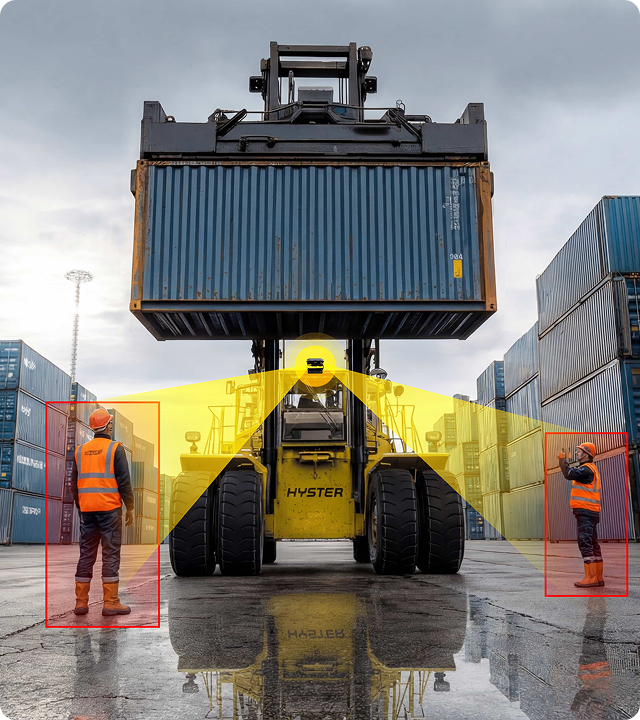
For Nathan McKenzie, CEO of Speedshield, who devised its AI-powered pedestrian detection system, AiVA, to tackle preventable injuries and fatalities caused by heavy industrial machinery, the issue goes beyond operator error or non-compliance. He believes many industrial sites are still relying on outdated approaches to safety in environments that have become faster, busier, and more complex than ever before.
“Spend a few days on a warehouse floor and you realize pretty quickly that forklift safety is something workers have to think about every hour of every day, regardless of the safety protocols put in place” McKenzie said. “Any environment where a forklift is used, whether it’s a manufacturing plant, a distribution center, or as part of a mining operation, share something in common—they’re constantly moving. Operators are navigating tight spaces, people are crossing shared walkways, pallets are stacked high, and everybody is working under pressure to keep things ticking along at speed. When ‘stuck-by’ and other vehicle-related incidents occur, it’s easy to assume it’s because somebody wasn’t following safety procedures. But that’s rarely the case.”
McKenzie said in his experience, these incidents tend to occur during ordinary moments that escalate faster than people are able to react—a worker steps into an operator’s blind spot while carrying out a routine task, or an operator focuses on maneuvering a load and loses visibility for a second or two. In busy sites where alarms, reversing buzzers, radios, and machinery are all competing for attention at once, it becomes very easy for important warnings to simply fade into the background.
“I think National Forklift Safety Day is important because these incidents are still affecting thousands of workers and families every year,” McKenzie said. “Behind every statistic is somebody who went to work expecting a normal shift and ended up seriously injured, or worse. At the same time, there’s a real opportunity for the industry to rethink how training, site design, and technology all work together to reduce preventable accidents.”
Advanced object and pedestrian detection features aren’t mandated safety features for all industrial trucks, but they are a safety-related technology, helping operators make better decisions within a busy warehouse. What’s more, with vision/AI-based solutions, there is no tag or beacon infrastructure to add to key points like rack uprights.
Alex Johns, the new president of ELOKON North America, said there are advantages of vision-based object detection versus other technologies like tags or LiDAR.
“The biggest thing that jumps out is that you don’t have to carry anything extra,” Johns says. “With tag-based systems, you’re always relying on a human not to forget their badge. With LiDAR, you’re dealing with a very “linear” way of seeing—it’s basically just breaking a light plane.”
Vision-based objection/pedestrian detection is often deployed in situations where the end user has a fairly large mixed fleet of trucks from more than one OEM.
“In the U.S., about 85% of facilities are running a ‘mixed fleet’—they might have a Crown here, a Raymond there, and a Hyster over there,” Johns added. “You can’t have a safety system that only speaks one language. You need a system that fits the environment, not just the truck, because the safety variables change from one corner of the warehouse to the other.”